
Planning for New Hampshire’s Aging Future: Why the State Plan on Aging Matters
As the second-oldest state in the nation, with a population that will continue to age, how well-prepared is New Hampshire to meet the needs of today’s older residents and the generations who will follow?
One important tool for addressing that question is the New Hampshire State Plan on Aging, a four-year plan that guides the state’s efforts to understand, serve, and support older adults. And as New Hampshire begins developing its next plan, residents, family caregivers, service providers, and other community members will have opportunities to share their experiences and perspectives through surveys, listening sessions, and other public input activities.
“New Hampshire’s State Plan on Aging provides the roadmap for meeting the needs of our growing older population,” says Thom O’Connor, Home & Community-Based Services Administrator at the Bureau of Adult & Aging Services (BAAS). If you can’t get to it or if it needs too much work, we’ll just need to figure out when makes the most sense to send it. “Without a plan, we react to challenges. With a plan, we build a future where every older adult has the opportunity to live well and age with confidence.”
What is the State Plan on Aging?
Developed and administered by the New Hampshire Department of Health and Human Services’ BAAS, the State Plan on Aging is part of the federal Older Americans Act (OAA) of 1965, which calls for each state to develop and maintain a plan for its aging population.
New Hampshire’s current State Plan on Aging covers October 1, 2023, through September 30, 2027. As that plan approaches the end of its four-year cycle, the state is beginning to develop its next plan. This is an opportunity to look at the needs of New Hampshire’s older population, identify where additional support is needed, and determine what the state should prioritize in the years ahead.
“The State Plan on Aging transforms vision into action. It provides a framework for decision-making, helping New Hampshire target resources where they will have the greatest impact for older residents and their families,” O’Connor explains.
Why Is the State Plan Important?
As New Hampshire’s population continues to age, the demand for services and supports will grow and change. Planning for what that may look like is essential.
Making New Hampshire a great place to live as people age requires meeting a variety of needs, from healthcare and reliable transportation to opportunities for social connection and services that allow them to remain in their homes and communities for as long as possible. Family caregivers also need support, information, and resources to help them manage the responsibilities of caring for a loved one.
These needs are interconnected. The State Plan on Aging provides an opportunity to look at these issues collectively rather than addressing them in isolation.
“The State Plan on Aging is New Hampshire’s vision for the future,” says O’Connor. “It reflects our commitment to ensuring that every older adult has the opportunity to age with dignity, independence, security, and purpose, while providing a framework to meet the needs of our changing population.”
The Planning Process Matters Just as Much as the Plan
While the final document is an important guide, the process used to develop it is equally significant.
A meaningful State Plan on Aging reflects the experiences and priorities of the people it is intended to serve. That means involving older adults, family caregivers, service providers, advocates, community organizations, and other stakeholders in identifying needs and shaping priorities. It also means recognizing that older adults are not a single, uniform population. Their experiences, circumstances, and priorities vary considerably depending on where they live, their financial resources, health, family support, and access to community services.
“The strength of the State Plan on Aging is rooted in the planning process itself. A comprehensive approach ensures that the voices of older adults across New Hampshire are heard, valued, and translated into meaningful action,” O’Connor says.
Make Your Voice Heard
As the Department of Health and Human Services prepares for the next State Plan on Aging, there will be opportunities for the public to share their perspectives and help identify priorities.
How can you get involved? Take time to complete the upcoming survey, attend a listening session, and share your thoughts about what older adults and their families need to thrive in New Hampshire. Listening sessions will take place as follows and will offer both in-person and virtual attendance:
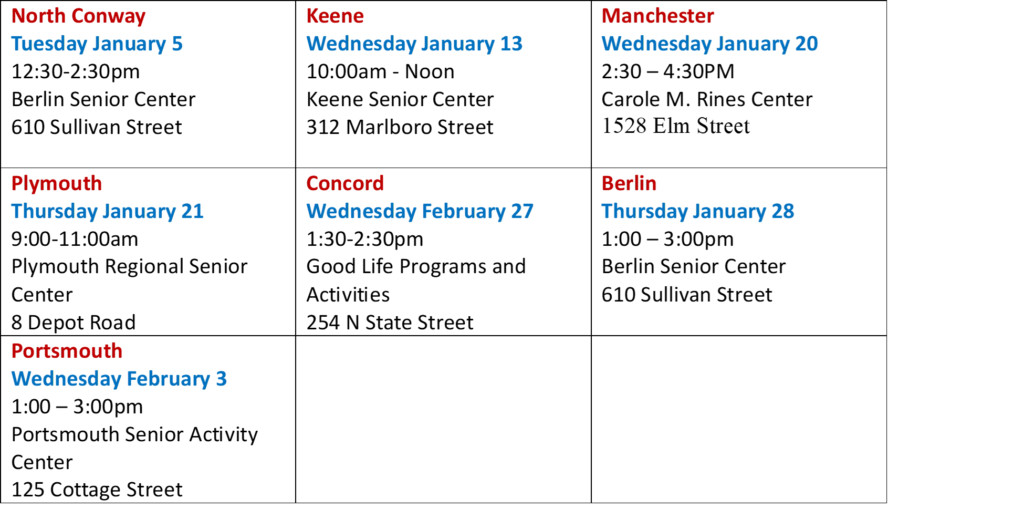
You can also help spread the word by sharing these opportunities with friends, family members, colleagues, and others in your community. The more voices and perspectives included in the process, the better the state can understand the needs and priorities of its aging population.
Please check the State Plan on Aging webpage and look for announcements about how to participate in upcoming opportunities in the months ahead and consider how you can be part of shaping New Hampshire’s aging future.